

In January I wrote about CES and what I called Britain’s AI question: whether a country with real strength in the brain of artificial intelligence, the models and the research talent, was giving enough thought to the body that puts it to work. In July an answer of sorts arrived, from two directions in the same week. Both should have made more noise than they did.
The noisy one was Shanghai. The World Artificial Intelligence Conference ran from 17 to 20 July, with more than 1,100 exhibitors and over 300 global product debuts. The quiet one was London: on 20 July the Office for National Statistics published its first combined view of how UK businesses actually use AI. It sank without trace. Read together, they point to a problem the UK debate has failed to name: an economy that adopts AI broadly but, as the figures below show, barely changes how it works.
From performing to working
I was not in Shanghai this year, but the reporting from the exhibition halls, which I followed from various angles, tells a clear story. For years, the question at these events was whether a machine could do a task at all. This year the large language model slipped backstage: roughly 70% of main-hall exhibitors were showing AI agents, and the number of embodied intelligence exhibitors rose from around 80 to more than 200. Last year’s robots somersaulted and danced for photographs. This year the Chinese financial press described a humanoid from Leju working a replica factory line for more than eight hours a day, with versions of the same system already running in customers’ factories. A backflip draws a crowd; eight unbroken hours on a packing line draws a purchase order.
The usual caution applies. These are company demonstrations reported by exhibitors and state media, and a working cell in an exhibition hall is not a national rollout. But the shift in what the industry considers worth demonstrating is itself the news. Reliability under real operating conditions has replaced raw capability as the thing worth proving. That is something.
A mile wide and an inch deep
Since late 2023, self-reported AI use among UK businesses has nearly tripled, from around 12% to around 35%. Over the same period, the average number of AI technologies per adopting business, the ONS’s own proxy for intensity of use, has crept from 1.4 to 1.6. The survey asks about six categories, so readers can judge the menu for themselves: large language models (used by 18% of businesses), visual content creation (16%), machine learning for data processing (12%), image processing (6%), robotics (2%) and other AI technologies (2%). Adoption has tripled; intensity has barely moved.
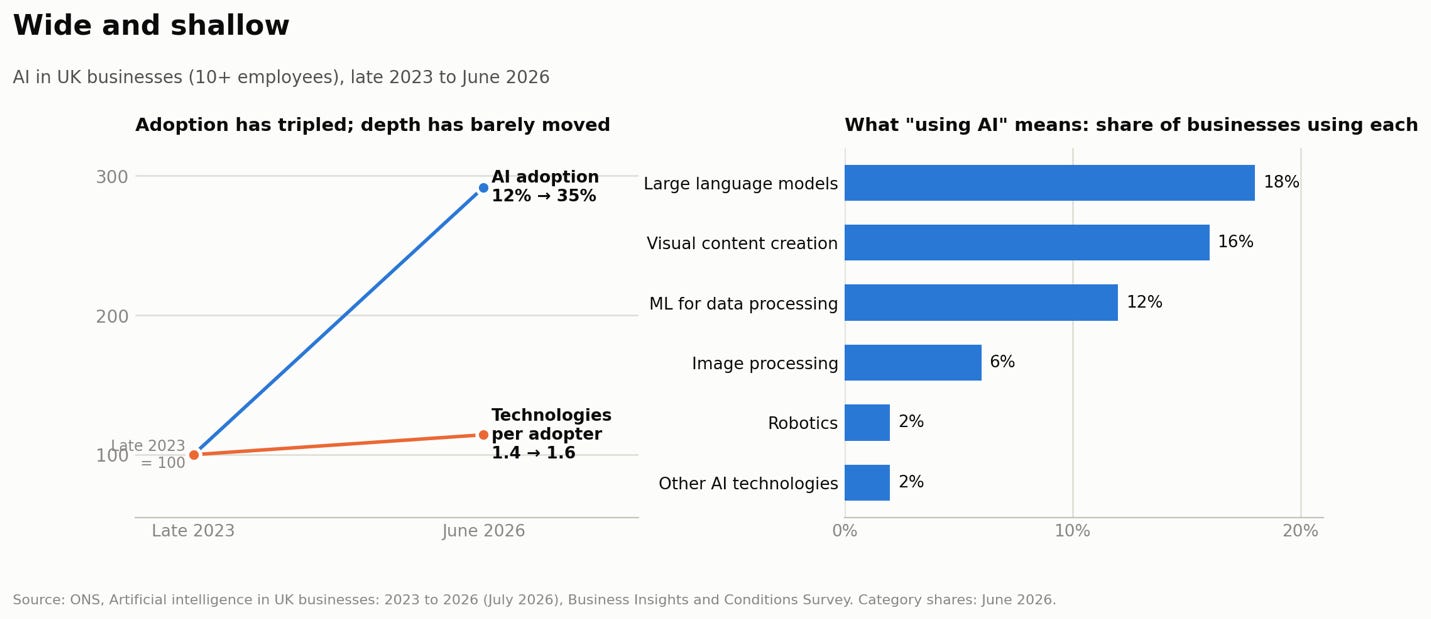
The caveat is that nobody yet has an agreed way to measure the depth of AI use; the ONS says as much about its own proxy. The problem is hardest in services, where the technology disappears into everyday workflows rather than standing on a production line waiting to be counted. That is why the pattern across the release matters more than any single number. More than 60% of adopters use AI to improve existing operations, while fewer than one in five use it to create new products or enter new markets; whichever yardstick one prefers, they all point the same way. This is broad, task-level adoption — a marketing team drafting copy, a finance function flagging anomalies — layered onto unchanged processes.
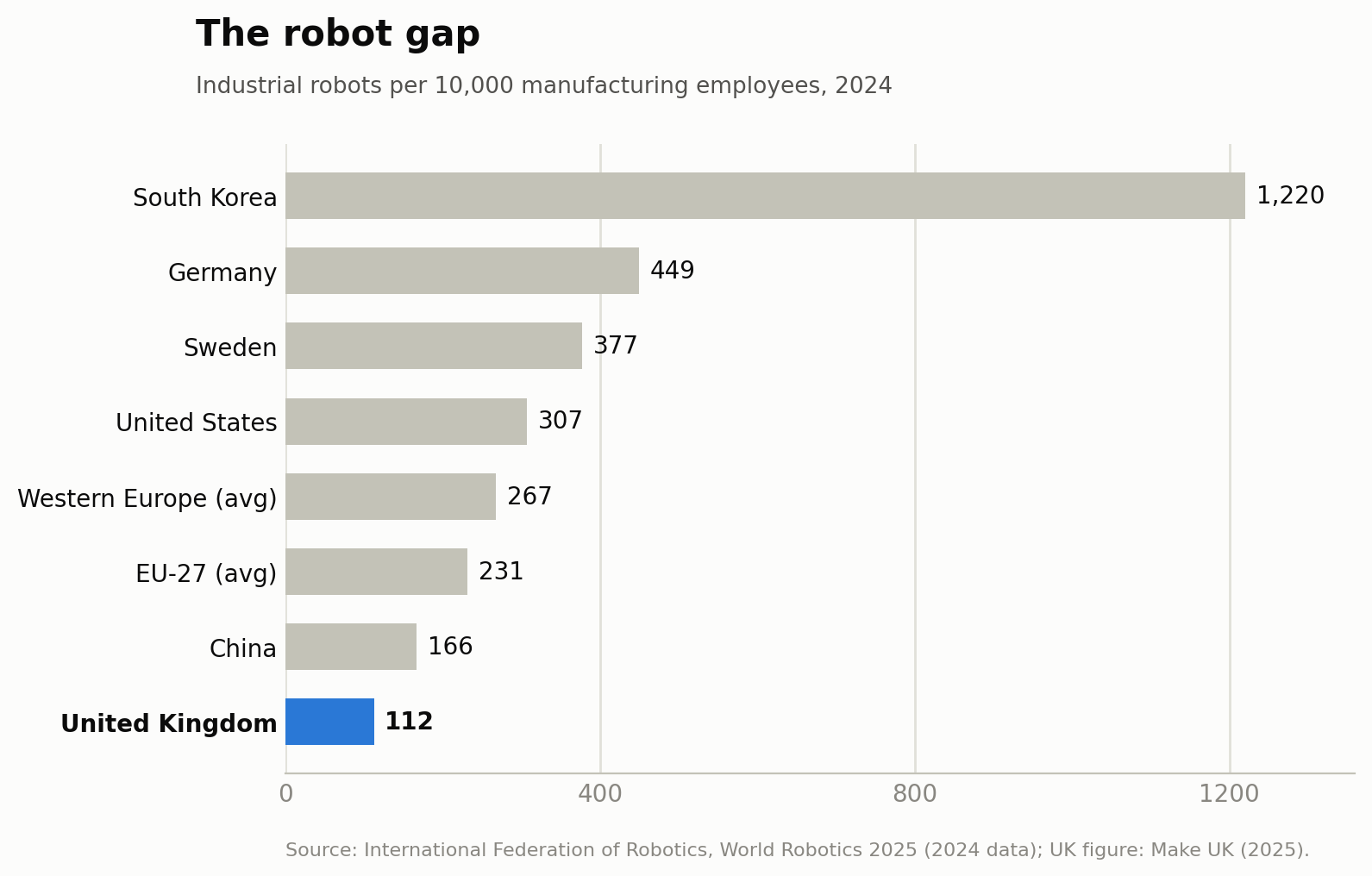
The robotics number is the starkest. Make UK puts UK robot density at 112 robots per 10,000 manufacturing employees, against an EU average of 208; the International Federation of Robotics puts Western Europe at 267. The fair comparison is with France and the Netherlands, economies almost as services-dominated as Britain, with services around 71% of GDP against 73% in the UK, yet both in the global top twenty for robot density, in the EU, whose average is roughly double the UK level. Britain’s services structure makes this more relevant, not less. Language models are the first general-purpose technology whose natural habitat is the office rather than the factory floor, so a services economy has the most to gain from absorbing them deeply and the most to lose from adopting them shallowly. A law firm that bolts a language model onto unchanged workflows is making the same mistake as a manufacturer that parks a robot beside an unreformed production line.
The constraint is absorption, and a productivity problem
A phrase common in Chinese AI circles translates as “a day in AI is a year in the human world”. The technology moves in days; corporate planning moves in quarters; organisational change moves in years. Much of the debate around WAIC was about exactly this mismatch — no longer whether the technology works, but whether organisations know how to work with it. An MIT survey found last year that 95% of firms saw no profit-and-loss effect from their AI pilots; the few that did had reorganised the work around the technology, and typically recovered their investment within months. The constraint, in other words, binds on both sides of this comparison: absorption. China is responding with a large, state-funded experiment in deployment. Most of it is no model for Britain, and a good deal of the capital will be wasted. But each installation teaches its firm what breaks, which roles have to change and what the technology is worth in a working business, and that kind of knowledge cannot be imported later. Britain is producing very little of it.
None of this is a technology-access problem. UK firms can buy the same robots and license the same models as firms in Bavaria. What too many lack is organisational capability: the capacity to redesign processes, roles and management practice so that a new tool becomes central to how work is done, rather than bolted on. In my research with colleagues on skills and training covering some 19,300 firm-year observations of UK businesses between 2011 and 2019, we found the same mechanism in an older setting: what raised productivity was not more training but training aimed at professional and technical staff, the people who rebuild how a firm works, which yields roughly double the returns of general provision. The lesson here is not about training as such. It is that returns flow to firms able to reorganise around new methods, and those firms are not the majority. That evidence says nothing about AI, and I would not claim it does. It documents a general capability, and the ONS figures above are what it looks like when a new technology arrives in an economy where that capability is thin.
This is why the AI Opportunities Action Plan, built around compute, models and talent, addresses only part of the problem. Those are reasonable things to want, but they are inputs to a supply of technology that is not scarce. The scarcity is on the demand side, in the median firm: fifty employees, no data function, and no realistic route to the process redesign that would make any of it pay. In this sense, Britain’s AI problem is its productivity problem.
The race Britain is actually in
In January, the question I took from CES was whether Britain could build a body to match its considerable brain. The Shanghai conference has sharpened it somehow. It is not about the machines; the lesson was an industry turning its attention from what the technology can do to how organisations learn to work with it. That is the race Britain is in — the same one it never quite ran with robots, with digital adoption, or with management practice. The technology changes, but the constraint does not.