

Friedrich Merz came home from China last week and told Germans they need to work harder. After touring a robotics factory in Hangzhou and meeting China’s tech vanguard, the chancellor declared that Germany is “simply no longer productive enough” and that prosperity cannot be maintained with “work-life balance and a four-day week.”
I’ve spent a lot time studying trade, productivity and the Chinese economy in the UK. When I heard those remarks, my first reaction was: he’s identified a real problem. My second was: he’s prescribed exactly the wrong medicine. And my third — the one that stayed with me — was: this isn’t just a German mistake. Britain has been making the same diagnostic error for years.
The wrong prescription
Merz’s conflation of working hours with productivity is the kind of error you’d expect to get marked down for in a first-year economics exam. Germany already works among the fewest hours in the OECD. Its output per hour is among the highest in the world. The problem isn’t effort, it’s the structural conditions in which that effort takes place: chronic underinvestment, regulatory sclerosis, deteriorating infrastructure, soaring energy costs.
China didn’t overtake Germany in key manufacturing sectors because Chinese workers tried harder (despite that they indeed work extremely hard). It did so because the state invested strategically and at enormous scale, and because it built industrial ecosystems — dense clusters of interconnected firms, suppliers and institutions — that generate a form of distributed intelligence no single European country can match. A viral post by a European tech entrepreneur named Mehdi captured this vividly: he completed four prototype iterations in Shenzhen’s Huaqiangbei district in a week for under $1,000; back in Europe, a colleague spent $12,000 on a single revision and waited two months. His verdict on Merz: it’s like telling a horse to run faster when the other side has already built the internal combustion engine.

Photo credits to Hardwork: It shows a market hall in Huaqianbei in Shenzhen, a typical hall among many in this district that covers an incredible 21 million square meters, contain millions of stalls, and represent a number of manufacturing firms in Shenzhen.
UK version of the same mistake
Now here’s why this matters to us in the UK. Britain has its own productivity puzzle, and it is arguably more stubborn than Germany’s.
Between 1997 and 2007, UK output per hour growth was the second fastest in the G7. Between 2009 and 2019, it was the second slowest. Since the pandemic, productivity has barely grown at all — in Q4 2025, output per hour was just 2.4 per cent above its pre-Covid level and actually fell year-on-year. British workers produce roughly 10 per cent less per hour than their German counterparts, 18 per cent less than the French, and over 20 per cent less than Americans. For a country that left the world’s largest single market partly on the promise of greater dynamism, these numbers are damning.
The causes are painfully familiar. Business investment as a share of GDP has been among the weakest in the G7 for decades. Post-Brexit trade barriers have hit small firms and high-tech manufacturing hardest. Infrastructure spending has been repeatedly deferred. Workplace training has declined — in 2024, only 11 per cent of employees reported receiving job-related training in any given month.
But Britain is not Germany — and that matters
Here is where the conversation needs to get more nuanced. Germany is still, at its core, a manufacturing powerhouse — manufacturing accounts for around 19 per cent of its GDP. Britain’s manufacturing sector, by contrast, contributes roughly 8 to 9 per cent of GDP, though it punches above its weight in value-added terms and remains critical for exports, innovation and regional employment. The UK is fundamentally a services-driven economy, with services accounting for around 80 per cent of output.
This means the Shenzhen ecosystem model — dense manufacturing clusters enabling rapid physical prototyping — cannot simply be transplanted onto the British economy. The question for the UK is not how to replicate Huaqiangbei. It is how to build equivalent ecosystem density and dynamism in the sectors where Britain actually competes: professional and business services, fintech, creative industries, life sciences, higher education, as well as advanced manufacturing.
Research by The Productivity Institute has shed important light on this. One of the most striking findings is the UK’s “long tail” of low-productivity firms. Britain has world-class frontier companies — but the diffusion of technology, management practices and innovation from these leaders to the rest of the economy is painfully slow. Between 1997 and 2023, the number of firms below the 25th productivity percentile nearly doubled. The UK is, as the Bank of England’s Andy Haldane once put it, a “hub with no spokes”: brilliant at the centre, but with too little connective tissue transmitting that brilliance outward.
Haldane’s diagnosis was valuable, and his comparison with Germany’s Fraunhofer institutes — arguing that the UK’s Catapult Centres are a success but smaller in scale, functioning more as innovation engines than diffusion engines — was well made. But I would argue it does not reach the deepest root of the matter. The conventional framing treats diffusion as a supply-side problem: build better institutions to push innovation outward. The real engine of diffusion, however, is demand. It is the use of innovation — startups and small firms competing fiercely at the downstream end of value chains, demanding better tools and cheaper processes because their survival depends on it. This is precisely why Shenzhen’s ecosystem works: hundreds of competing founders create relentless demand for rapid iteration, and the suppliers get smarter because their customers are relentless. The intelligence emerges from the demand side, not from designed intervention alone.
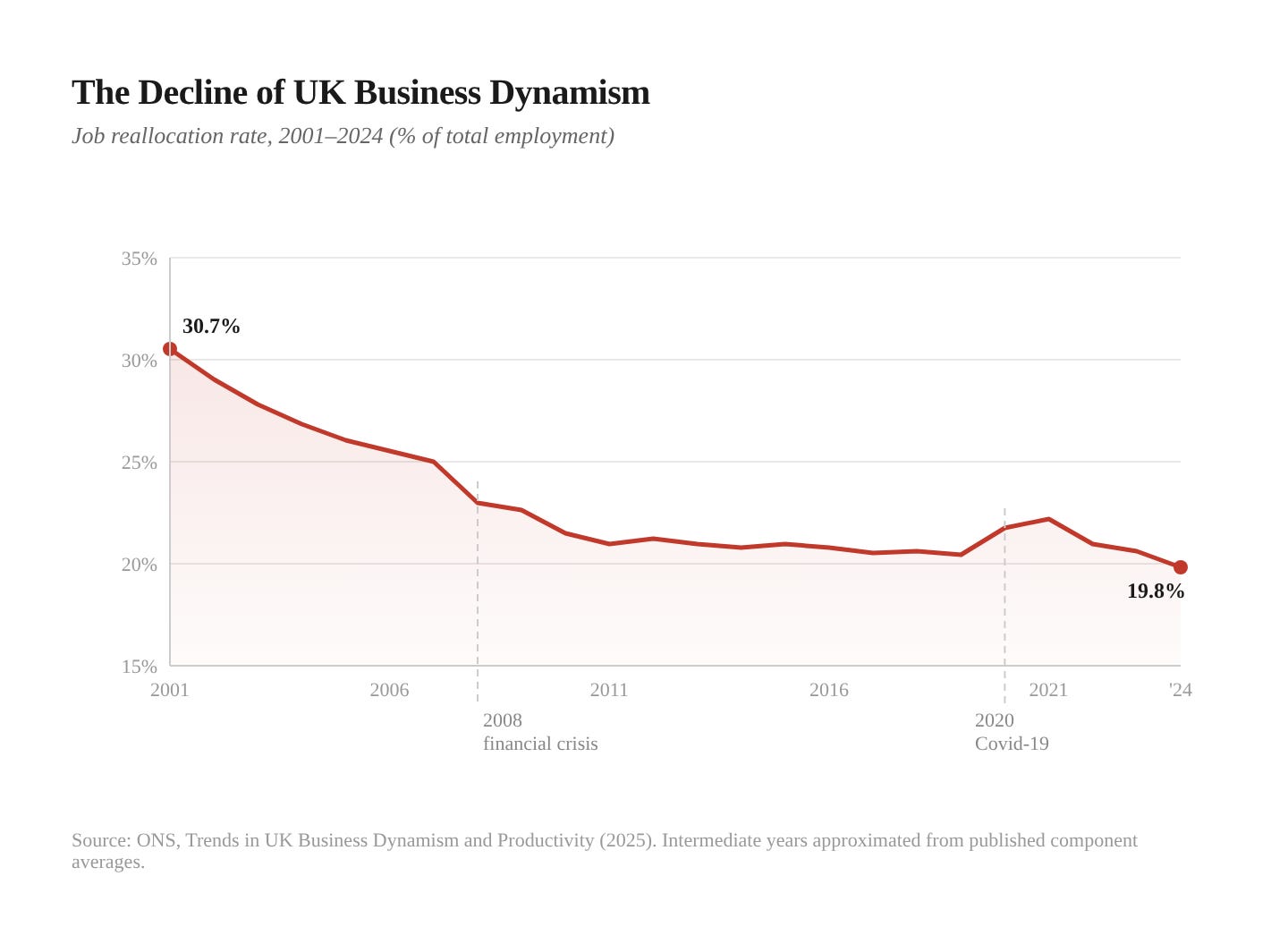
In Britain, that downstream demand ecosystem is arguably weak, and getting weaker. There are simply not enough businesses competing intensely enough at the downstream end of production chains to pull innovation through. There are also signs that business dynamism — the mechanism through which economic resources are allocated to more productive firms through firm entry, growth and exit — has been slowing down. That in turn helps explain the low adoption of new technology. Only 7 per cent of UK firms use Internet of Things technologies at high intensity; just 11 per cent use big data meaningfully; and as recently as 2023, only 9 per cent had adopted AI. These are not frontier technologies — they are mature tools that competitors have already absorbed. The problem is not that the innovation doesn’t exist. It is that the innovation-using sectors of the economy are not dense or scaled enough to generate the feedback loops that make ecosystems work — the kind of loops that, in Shenzhen, drive suppliers and innovators to improve because their downstream customers are numerous, demanding and relentless.
What would a serious response look like?
If the problem starts at the bottom — with innovation-using sectors that are too thin and too fragmented to generate the ecosystem feedback loops that drive productivity growth — then the first priority is building density at the downstream end. This is partly a structural consequence of the UK’s industrial specialisation. A services-heavy economy will not naturally produce the kind of dense, interconnected downstream demand that a manufacturing ecosystem like Shenzhen generates. The long tail will not shorten by pushing technology at firms that have no competitive reason to adopt it. It will shorten when the downstream ecosystem is dense and hungry enough to pull innovation through.
That means, domestically, Britain needs greater business dynamism — more startups, more competitive entry, and fewer barriers preventing small firms from scaling. But it also means looking beyond borders. When British firms are deeply integrated into cross-border value chains — working with partners in countries that specialise in scale production — they are exposed to competitive pressures, new practices and technological standards that no domestic Catapult programme can replicate. Openness and international collaboration may be the most powerful mechanism for building the scale and scope economies that the UK’s domestic industrial structure cannot generate alone. The erosion of these linkages post-Brexit is not just a trade story. It is a productivity story.
Third, we need to stop treating manufacturing and services as separate policy domains. Dani Rodrik has argued, persuasively, that we need an industrial policy for services. He is right, but the corollary is equally important: a services-economy strategy that ignores manufacturing will fail. Helping firms cross the boundary between the two — through advanced manufacturing capabilities embedded in service offerings, through cross-border servitisation, through the kind of design-finance-IP-logistics integration that sits at the high-value nodes of global production networks — is where Britain’s comparative advantage lies. This is not about rebuilding mass production in the Midlands or the North. It is about ensuring British firms are indispensable partners in international manufacturing-services systems.
Fourth, management practice and workplace training remain stubbornly underinvested. Only 11 per cent of employeesreported receiving job-related training in 2024. These are the mundane but essential foundations without which no amount of strategic ambition will translate into productivity gains on the ground.
Finally, the government’s new industrial strategy gestures in the right direction, but Britain has a long history of announcing strategies that do not survive the next spending review. In an age of rapid technological change — where AI stands to reshape the 23 per cent of UK GDP concentrated in knowledge-intensive services — the ability to implement industrial strategy with agility, to iterate and adapt rather than publish and forget, may matter more than the strategy itself.
The real lesson
The temptation for politicians — in Berlin, in London, everywhere — is to reach for the simple story. If we’re falling behind, we must not be working hard enough. It flatters the instinct that national success is a matter of character rather than strategy. But the lesson from China is not about effort. It is about architecture — and every country needs to design its own.
Germany’s challenge is to restore dynamism in its manufacturing heartland. Britain’s is different and in some ways harder: to build ecosystem density in a services economy where the assets are intangible, the clusters are digital, and the long tail is enormous. We have world-class universities, deep financial expertise, globally competitive creative industries and a natural advantage in the English-speaking knowledge economy. What we lack is the sustained investment, institutional coordination and political seriousness to turn these into a coherent productivity strategy — one that recognises manufacturing and services as parts of the same system, not rival claimants for attention, and that looks beyond borders for the scale our domestic economy cannot generate alone.
Merz saw the future in Hangzhou and came home telling Germans to work harder. It was the wrong answer. Britain’s productivity crisis is older, deeper, and in some ways more structurally entrenched — and it demands a seriousness about openness, partnership and institutional design that British politics has yet to demonstrate.

Jun Du is professor of economics at Aston Business School, Director of Centre for Business Prosperity, specialising in trade, productivity and the Chinese economy. I write regularly on UK economic policy and global trade.
This seems broadly right to me. I do think we need to acknowledge that the competitive pressure and dynamism in (some) Chinese industries comes from the extraordinary size of the market though - even niche industrial applications will be highly competitive. The UK will never fully replicate this (even if we rejoined the EU).
Incidentally I work in a globally competitive UK services firm, and I struggle to finance any sort of professional development for our staff - senior management believe in learning on the job - which is troublesome in a wfh world.
A very good read. The firms in the long tail aren't simply unaware of better tools, many are operating in communities and industries where the identity is built around preserving what exists rather than competing toward what's possible. Post-industrial Britain has developed a relationship with its economic past that actively resists the kind of restless iteration Shenzhen runs on.
I write about this through a framework I call the Museum and the Frontier, the idea that modern economies contain two distinct spheres with fundamentally different approaches to identity, memory, and progress. You've diagnosed the economic symptoms. My work tries to explain the cultural pathology underneath them.